


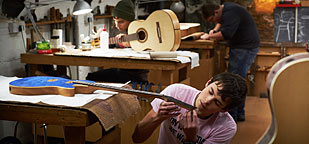









Course Details
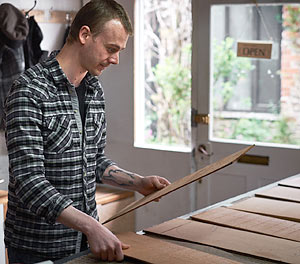
Course Details
From the beginning, students are guided towards understanding how instruments perform at their best, how the tools do their work and why the materials can be made with the shape, the strength or the lightness required. Recognising the properties of materials and tools, how they relate to the finished guitar, and learning how to handle them is the heart of the course.
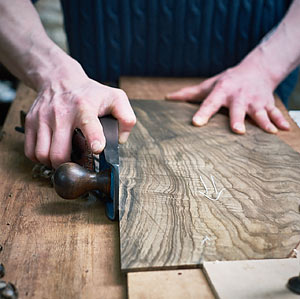
In order to do this well, the work is done almost exclusively with hand tools using traditional methods. This has the added benefit of ensuring a comfortable environment in which to share ideas and information and the methods learnt can then be repeated without a large investment in machine tools. Even students who have barely or never picked up a chisel before usually find no great difficulty in using them. Once shown the correct way to set up and use a tool for the task in hand the work makes more sense. And with repetition comes familiarity and confidence that it will work. The realisation that great accuracy - and with practise, speed - can be achieved with simple tools makes the work immensely satisfying. I believe the finest work is done by hand. In any case, however much machine tools and jigs may be used in a modern instrument maker's workshop to aid productivity, the use of hand tools remains the bedrock of the craft and a vital way to learn.
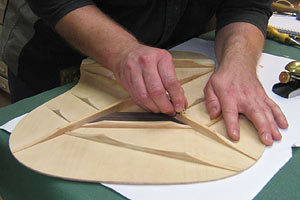
Small power tools are used where appropriate. Simple tasks such as drilling holes for machine heads (tuners) or routing cavities for pickups are examples of this. Cutting the rebates around guitars for decorative binding can be done by hand, but can be more consistent when cut with a router. And lacquering finished instruments is simply not feasible without a spraygun powered by compressed air. With all tools, safety is held equally important with skill in their use. With Phil's solid support, students take charge of every aspect of their work. From decisions about design, including what materials are to be used, they progress to making every part of the instrument themselves. When the time comes for separate parts to be glued together, the job might seem to be nearly done. In fact, there is much left to do.
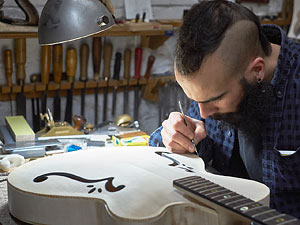
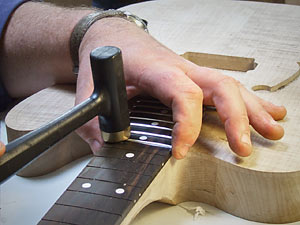
Fitting the decorative corner binding is followed by the part of the process whose precision and accuracy has a direct bearing on how the instruments plays and feels: working the fingerboard and the neck. A jig enables fret slots to be cut beautifully straight, but the trueness of the fretboard, which allows a low action and clean sound, is the result of careful measurement and skilful technique. A well-shaped neck meanwhile is crucial if the instrument is to be played comfortably over long periods of time. Having a clear technique enables students to perfect the skill over time and the result is that the playability of finished instruments is regularly of an extremely high standard. If earlier stages are about artistry, and contribute to style and the kind of sound the guitar will have, this part delivers the purity of sound, and makes the instrument a dream to play.
The final two weeks are set aside for finishing, which involves a whole new skillset. Surface preparation is key, whether spraying lacquer, French Polishing or applying oil finishes. Careful, confident and even application is required to acheive a finish the satisfies the need for beauty and protection without negatively impacting the instrument's sound.
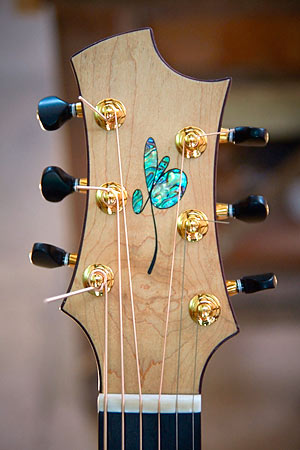
With the final stringing of each guitar comes the moment. They have already been heard, at a trial-stringing stage (which is before lacquering), but that takes nothing away from the now completely finished article. With no more work to do, the maker can enjoy the fruit of their twelve weeks hard work.
